
Repairing a Wooden Play System: What Can Be Fixed and What Should Be Replaced
By Jeff Rabkin, JustFix Wood · Published October 2, 2026 · Updated October 5, 2026
A wooden play system lives outside through rain, snow, sun and freeze-thaw cycles. The top may still look fine while the ends of boards, post bases and hardware connections are starting to fail.
I approach these repairs the same way I approach a deck: find the parts that have actually lost strength, keep the wood that is still sound, and do not cover up a structural problem with a cosmetic patch.
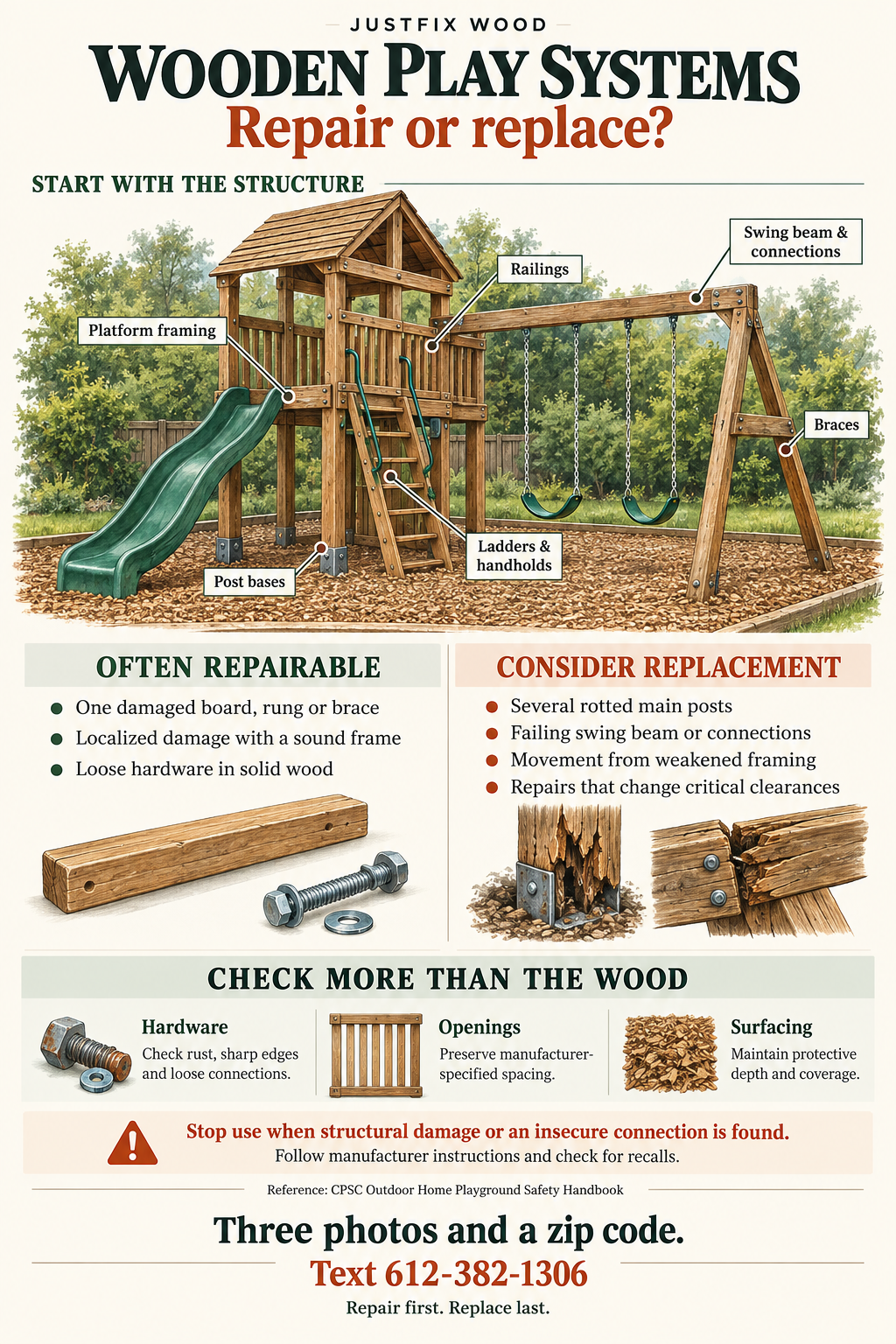
Wooden play system repair checklist: inspect the structure, hardware, openings and protective surfacing before deciding whether to repair or replace.
Start with the structure, not the accessories
Before worrying about a cracked canopy or a worn swing seat, I check the parts holding everything up:
- Posts where they meet the ground
- Platform framing and the boards directly beneath it
- Ladder and stair connections
- Railing posts and handholds
- Beam connections above swings, rings or climbing accessories
- Braces that keep the structure from racking side to side
Dark color alone does not prove that wood is rotten. I press suspicious areas with a screwdriver or awl. Sound wood resists. Wood that feels soft, crushes easily or lets the tool sink below the surface needs a closer look.
What can usually be repaired
Localized damage is often a good repair candidate. A single platform board, ladder rung, railing, brace or roof panel can usually be replaced without taking down the whole system.
Loose connections can sometimes be corrected with exterior-rated hardware that matches the original connection. Any replacement fastener needs to be suitable for outdoor use and compatible with pressure-treated lumber. I do not use drywall screws or ordinary interior hardware on a play structure.
The repair also has to preserve the original spacing around railings, ladders and openings. Changing those gaps without thinking can create places where a child's head, neck or clothing can become trapped.
Source: U.S. Consumer Product Safety Commission — Outdoor Home Playground Safety Handbook
When replacement is the safer answer
I get cautious when rot is no longer limited to one replaceable part. Replacement may make more sense when:
- Several main posts are soft at or below the soil line
- The swing beam or its main connections are split or badly deteriorated
- The platform moves because multiple framing members have lost strength
- The structure has been repeatedly altered with mismatched parts
- Replacement parts cannot be installed without changing critical clearances
- The manufacturer has recalled the model or a major component
A new board does not make a weakened frame safe. If the main load-bearing pieces are failing, I will say so rather than bolt new wood onto something I do not trust.
You can search current and past product recalls by brand or model before repairing an older system.
Hardware deserves its own inspection
Wood movement works bolts and screws loose over time. I look for missing washers, exposed threads, open S-hooks, sharp edges, rusted connectors and bolt ends that stick into a climbing or play area.
Loose hardware should be tightened, but a bolt spinning in soft wood is not fixed by tightening it harder. The damaged wood or connection needs to be repaired first.
The Consumer Product Safety Commission recommends maintaining hardware, replacing missing or damaged parts and checking equipment regularly. The original manufacturer's instructions should control whenever they are available.
Source: U.S. Consumer Product Safety Commission — Playground Safety
Do not forget the ground below
Repairing the wood is only part of the safety check. Protective surfacing should extend around the play area, remain deep enough to absorb a fall and be free of hard obstacles. Loose-fill material gets kicked away and compressed, especially under swings and at slide exits, so it needs regular raking and replenishment.
The CPSC handbook gives specific surfacing depth and use-zone guidance for home playground equipment. Those distances vary around swings, so I use the handbook and the manufacturer's instructions rather than guessing.
Source: U.S. Consumer Product Safety Commission — Outdoor Home Playground Safety Handbook
A practical seasonal check
I recommend checking a wooden play system at the beginning of the season and again during periods of heavy use. Walk around it slowly. Push on the posts, platform and railings. Look underneath horizontal boards and around every connection. Check the surfacing after storms and after it has been displaced by play.
Stop using the affected part when you find soft structural wood, a moving post, a split beam or a loose connection you cannot tighten securely. A small repair is easier to plan before the failed part starts pulling on the rest of the structure.
If you are not sure what you are looking at, send me a few wide photos plus close-ups of the damaged wood and hardware. I can usually tell whether it looks like a focused repair or whether the entire system deserves an in-person inspection.
Need this fixed?